
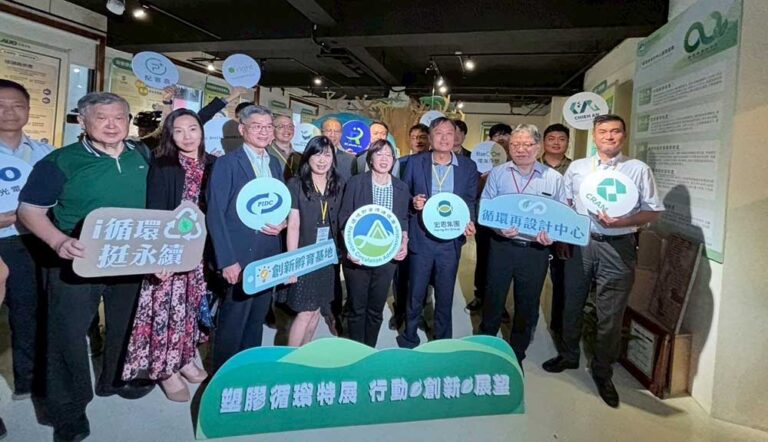
While the world is grappling with plastic pollution, Taiwan has quietly built a "national team" for recycled materials! Carbon Cycle Materials, as a member of this "Taiwanese national team," was invited by the Ministry of Environmental Protection's Resource Recycling Administration to participate in the "Plastic Recycling Exhibition," which aims to raise public awareness. The event also included a live connection to the United Nations' Global Plastics Convention...

From July 12th to 13th, 2025, five colleagues from Carbon Cycle Applied Materials completed a seminar organized by the Taiwan Chinese Labor Safety and Health Management Association...

From Waste to Low-Carbon Resources: ESG Sustainability Practices Implemented at CRAM Factory. On February 26, 2025, the British Office in Taiwan, the Ministry of Environment's Resource Recycling Agency, and environmental engineering consultancies visited CRAM International Industrial Co., Ltd. (a low-carbon circular plastic pelleting plant), one of the shareholders of CRAM's recycling tandem plant. They witnessed firsthand how Taiwan transforms waste into high-value resources. During the visit, CRAM demonstrated its plastic recycling process, including "recycling, dismantling, purification, and regeneration," and revealed its key technologies for processing over 55,000 tons of plastic waste annually. Guests witnessed firsthand how waste appliance plastic pellets are sorted and recycled into PCR plastic pellets that meet CBAM EU standards, with a carbon footprint only 1/10 that of virgin materials, impressing the international delegation. The British representative exclaimed, "Taiwan's average plastic recycling rate is so high (approximately 501 TP3T), far exceeding the international average (91 TP3T)!" The Ministry of Environment's exclusive photos reveal the process secrets: Why is CRAM's recycled material accepted by the EU? CRAM led the delegation on a tour of the waste plastic shredder, showcasing how it undergoes multi-stage purification, comprehensive property testing, melt processing, and plastic granulation—all part of the plastic recycling process. Officials from the Ministry of Environment paid particular attention to the "comprehensive property testing & quality inspection return" mechanism at each stage—from raw material traceability and process property monitoring to finished product carbon footprint certification—ensuring that every batch of materials complies with TUV dual certification (ISO14021/14067). From routers to ICs...

Introduction: Why should we understand the concept of low carbon? In today's era of climate change, "carbon" is no longer a simple chemical element, but a global circular economy...

Lin Xiu/Taipei DIGITIMES 2024/11/22 10:55 More than 90% of Taiwan’s companies are small and medium-sized enterprises. In the global supply chain system, they OEM for international brands and face tremendous pressure to reduce carbon emissions. Taiwan's Ministry of Environment's Resource Recycling Administration and Circular Economy Promotion Office and other government departments have gradually improved low-carbon economic policies to promote low-carbon industrial transformation and reduce carbon emissions. From November 6th to 8th, the 2024 TASS Asia Sustainable Supply + Circular Economy Exhibition was grandly held at the Kaohsiung Exhibition Hall. This is an important platform to connect circular industry resources and stimulate ESG innovative practices. Carbon Cycle Application Materials Co., Ltd. (CRAM) serves as PCR (Post-Consumer...

Helping companies achieve net-zero emissions goals As both the world and Taiwan are committed to promoting net-zero emissions by 2050, the specific practices of ESG have received increasing attention. CRAM can reduce approximately 322,528 metric tons of carbon emissions for the earth every year, which is equivalent to the carbon reduction of 1,329 Daan Forest Parks in one year. With this goal in mind, the company works closely with the Taiwanese government and international green economy advocates and is committed to providing low-carbon solutions for the circular economy. In addition to providing technical support, CRAM is more deeply involved in customers' carbon management processes, providing companies with carbon reduction plans and carbon emission reduction specifications, and signing annual PCR cycle material quantity controls with customers to help companies achieve annual carbon reduction goals. This all-round support allows companies to more effectively respond to carbon inventory challenges, further improve their performance in ESG scores, and enhance their international competitiveness. At the same time, CRAM also develops customized supply chain carbon reduction execution plans for brands and OEMs/ODMs, committed to creating carbon value for enterprises, enhancing low-carbon competitiveness, and helping them stand out in ESG indicators. Low-carbon circular supply chain...

During the TASS exhibition, CRAM had in-depth exchanges with visiting distinguished guests and deeply felt that manufacturers are in urgent need of low-carbon product solutions to transform into sustainable supply chains. Carbon Cycle Materials summarizes the five key points of manufacturers’ low-carbon transformation needs: 1. Sustainable sources of low-carbon materials: Manufacturers are looking for stable and certified sources of low-carbon cycle materials to meet brand owners’ demand for sustainable supply. chain requirements, and increasingly stringent carbon emissions and environmental protection regulations. 2. Carbon footprint transparency: Brands and manufacturers need to comprehensively track the carbon footprint of products and provide transparent carbon emissions information throughout the supply chain to meet the dual requirements of consumers and regulations. 3. Closed recycling system: In order to achieve the goal of net-zero transformation, companies need a closed cycle system that can efficiently recycle waste materials and regenerate them into new materials, thereby reducing resource consumption and enabling multiple recycling of materials. 4. Standard-compliant low-carbon certification: More and more brands and customers require suppliers to provide third-party low-carbon certification (such as TUV certification) to ensure that their materials and products comply with environmental standards. 5. Low-carbon material technology innovation: Enterprises urgently need advanced low-carbon material technology to cooperate in the development of low-carbon products, while ensuring product quality and reducing carbon emissions in the difficult category three of carbon inventory. Professional consulting services for low-carbon products CRAM is unique in that it not only provides high-quality PCR (Post-Consumer...

More than 90% of Taiwan's businesses are small and medium-sized enterprises, which are OEMs for international brands in the global supply chain system and face tremendous pressure to reduce carbon emissions. Taiwan's Ministry of Environment's Resource Recycling Administration and Circular Economy Promotion Office and other government departments have gradually improved low-carbon economic policies to promote low-carbon industrial transformation and reduce carbon emissions. ...

【TaipeiPLAS 2024】(9/24-928) and 【Taipei International Shoemaking Machinery Exhibition(ShoeTech...
The imperative for sustainable aluminum According to the International Aluminum Institute (IAI), recycling aluminum requires "less energy than producing the original metal...
 EN
EN  TW
TW